
Forging dies work under a punishing combination of high temperature and repeated mechanical impact — every hammer blow or press stroke drives hot billet material into the die cavity, and the die surface has to absorb that shock without cracking while still resisting deformation from the heat of the workpiece. Purohit Steel stocks the H11, H13 and H21 hot-work tool steel grades used across Indian forge shops for exactly this duty.
This guide focuses on the two failure modes that matter most for forging tooling — thermal fatigue and impact shock — and how to weigh them when choosing between H11, H13 and H21.
Table of Contents
- 1. Why Forging Dies Fail Differently
- 2. Hot-Hardness & Heat-Treatment Targets
- 3. Impact & Thermal-Shock Resistance
- 4. Which Grade Should You Choose
- 5. Why Purohit Steel for Forging Die Steel
- 6. Applications & Industries
- 7. Related Products
- 8. Authorized Stockist Brands
- 9. Cities We Supply in India
- 10. Our Services
- 11. Frequently Asked Questions
- 12. About Purohit Steel
- Our Certifications
- Countries We Export Worldwide
- Export Packaging & Shipping
- Quality Inspection & Testing
- Latest Price List
- MOQ & Payment Terms
- People Also Search For
Why Forging Dies Fail Differently
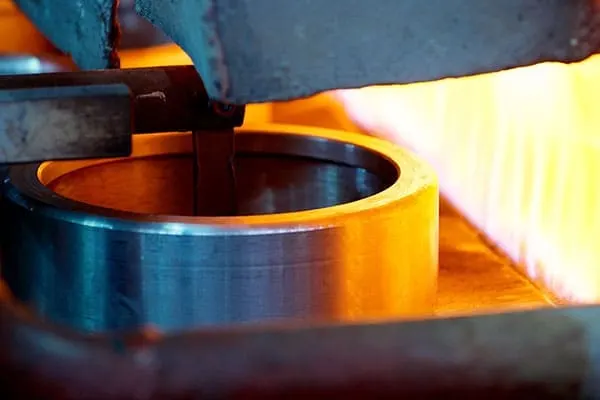
Unlike die casting, where molten metal flows smoothly into the die, forging drives solid, red-hot or white-hot billet material into the die cavity under a sudden mechanical blow — a hammer strike or a press stroke. That combination of high contact temperature and instantaneous mechanical shock is the core engineering problem for forging die steel:
- Thermal fatigue (heat checking): Each forging cycle heats the die surface on contact and cools it again between strokes, and this repeated thermal cycling opens fine surface cracks over time if the steel cannot absorb the cyclic stress.
- Mechanical shock: The impact of a hammer blow or press stroke, particularly in drop-hammer forging, imposes a sudden shock load that a brittle steel will chip or crack under, even if its hardness is adequate.
- Hot deformation resistance: The die must not soften or deform locally under sustained contact with hot workpiece material during each cycle.
Because forging is a cyclic-impact process rather than a continuous-contact one, toughness is usually weighted more heavily than raw hot-hardness when selecting forging die steel — a die that is slightly softer but tougher will typically outlast one that is harder but more prone to cracking under shock.
Hot-Hardness & Heat-Treatment Targets
Purohit Steel's H11 and H13 grade pages document heat-treated hardness of 44-54 HRC, with good retention of hardness and strength up to service temperatures of roughly 600-650°C — sufficient for the majority of hot-forging operations. H21 reaches 40-55 HRC and its tungsten alloying gives it superior red-hardness for sustained temperatures above 650°C, but this comes with a lower toughness margin and a quench-sensitive heat-treatment cycle that needs careful, controlled cooling — a real trade-off for impact-loaded tooling.
For forging dies, hardness is generally targeted toward the lower-to-middle part of the H11/H13 range (commonly around 44-48 HRC) to prioritise toughness and thermal-fatigue resistance over maximum wear hardness, since forging dies are far more likely to fail from cracking than from simple abrasive wear.
Impact & Thermal-Shock Resistance
H11 and H13 are both chromium-molybdenum-vanadium grades prized for toughness that holds up under repeated impact — H13 is described on its own datasheet as offering “very high toughness” alongside excellent thermal fatigue resistance, and H11 offers a very similar toughness profile with slightly deeper hardenability. H21, by contrast, is explicitly noted as having lower toughness than the Cr-Mo-V grades at equal hardness, along with quench sensitivity that makes it less forgiving in dies that see frequent, rapid thermal cycling from hammer or press impact.
This is why H21 is more commonly reserved for forging-adjacent tooling with lower impact loading — hot trim dies, hot shear blades and fixtures that sit close to flame or hot metal for extended periods without taking direct impact — rather than the forging die cavity itself.
Which Grade Should You Choose
| Forging Duty | Recommended Grade | Why |
|---|---|---|
| Drop-hammer / high-impact forging dies | H13 / 1.2344 | Industry-standard toughness and thermal-fatigue resistance, forgiving heat treatment |
| Press forging, large or complex die blocks needing deep hardenability | H11 / 1.2343 ESR | Very good toughness with excellent, deep and even hardening through thick sections |
| Hot trim dies, hot shear blades & sustained-heat forging fixtures (low impact) | H21 | Superior red-hardness above 650°C for sustained flame/hot-metal contact; not for high-impact cavities |
For the forging die cavity itself, H13 or H11 are the correct default; reserve H21 for adjacent, lower-impact fixtures where sustained heat is the dominant stress rather than shock loading.
Why Purohit Steel for Forging Die Steel
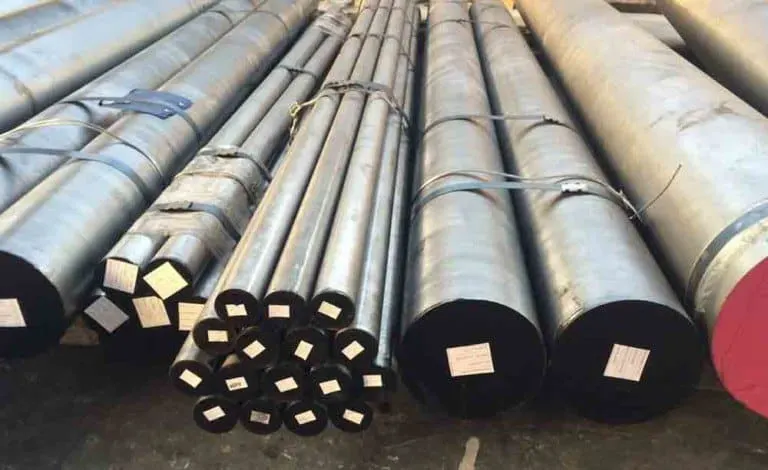
- Ready Stock: H11, H13 and H21 held in round bar, flat bar and block sizes for immediate dispatch
- ISO-Certified Quality: Documented quality management since 1965
- Authorized Stockist: Sourced through globally reputed manufacturers, including NLMK Verona and SeAH CSS
- Value-Added Machining: In-house bandsaw cutting, precision machining, grinding, drilling, gun drilling, EDM and wire-cut
- Technical Support: Grade-selection and heat-treatment guidance for forging tooling
- Pan-India & Export Supply: Warehousing in Vasai with a sales outlet in Mumbai
Applications & Industries
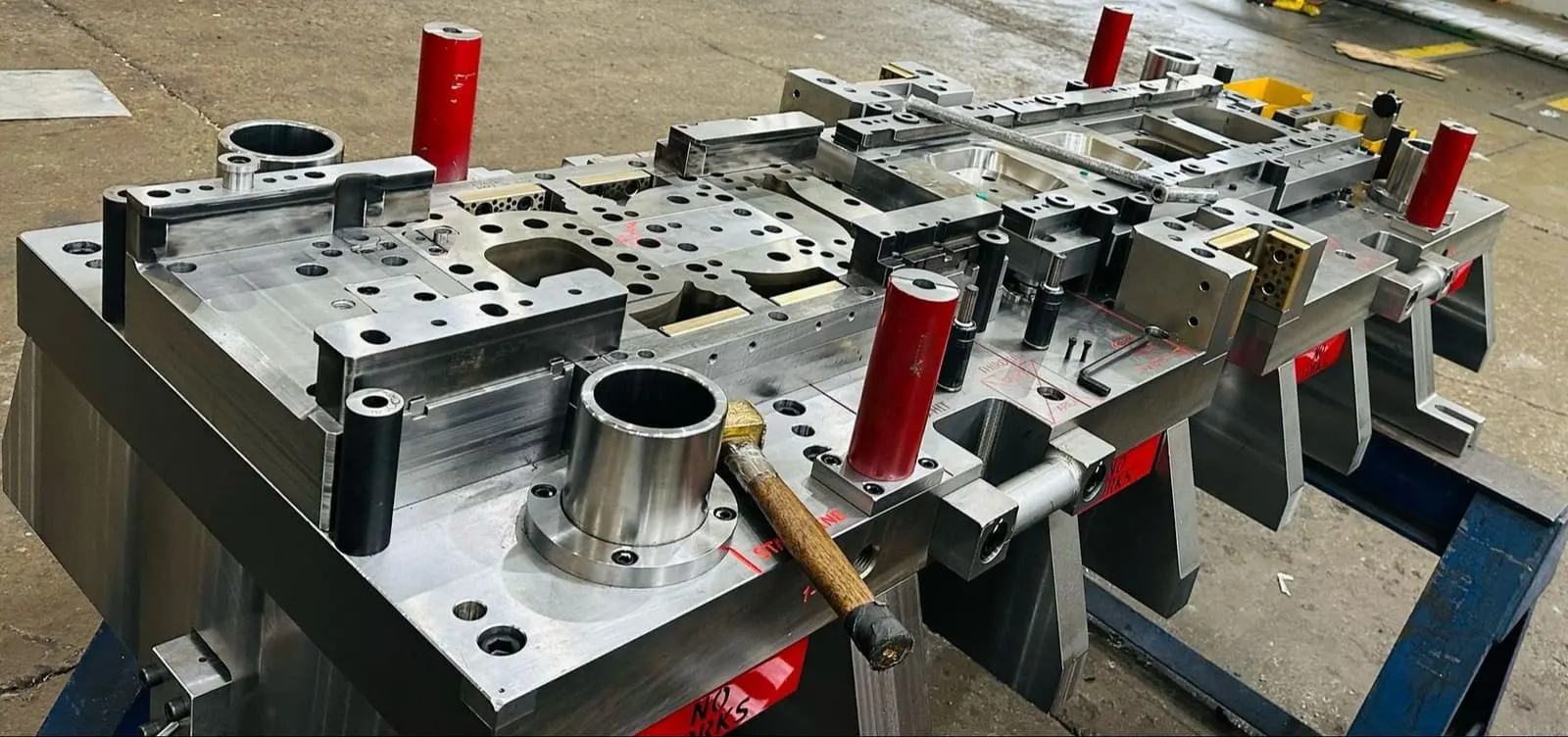
- Drop-hammer and press forging dies
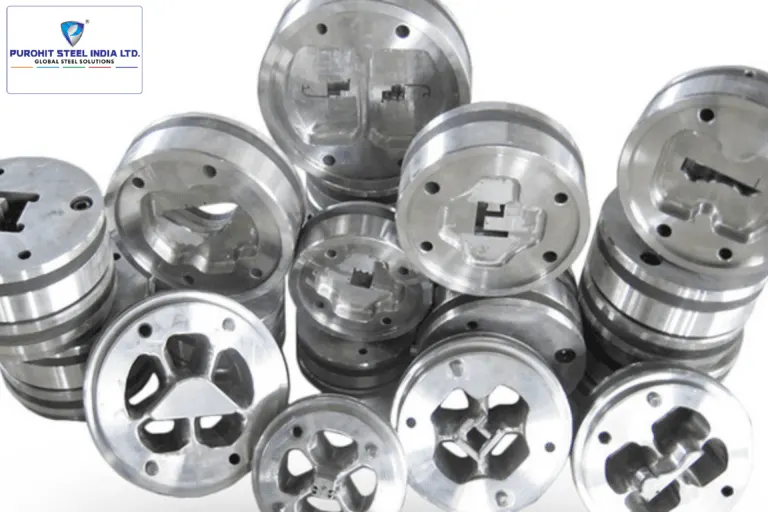
- Hot-forging die inserts and blocks
- Hot trim dies and hot shear blades
- Automotive and industrial component forging tooling
- Forge-shop general tooling and fixtures
Industries We Serve
- Forging industry
- Automotive component manufacturing
- Heavy engineering & machinery
- Tool & die industry
- Industrial manufacturing
Authorized Stockist



Forging Die Tool Steel Supply Locations Across India
We supply H11, H13 and H21 forging die tool steel across major industrial cities including Mumbai, Pune, Khopoli, Nashik, Aurangabad, Navi Mumbai, Palghar, Umbergaon, Vapi, Valsad, Daman, Vadodara, Ahmedabad, Rajkot, Hyderabad, Bangalore, Chennai, Cochin, Delhi, Gurgaon, Manesar and Sonipat — as well as to export markets.
Our Steel Products
Our Services
Frequently Asked Questions
About Purohit Steel
Purohit Steel was established in 1965 by Shree Bherumalji Rajpurohit, a visionary in metallurgy. Over the decades, we have built a strong reputation as a trusted stockist and exporter of tool steel, plastic mould steel and engineering steel products across India.
As an ISO-certified company, we source premium materials from globally reputed manufacturers and operate a modern warehousing facility in Vasai along with a sales outlet in Mumbai, enabling efficient storage, fast processing and timely delivery across India and export markets.
Read more about Purohit Steel, view our certifications, or get in touch with our technical sales team.
Our Certifications
Purohit Steel operates as an ISO-certified company, backed by documented quality management, safety and compliance certifications that support reliable supply to domestic and export customers.
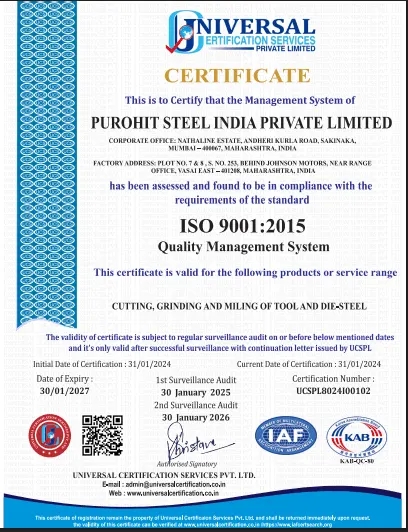
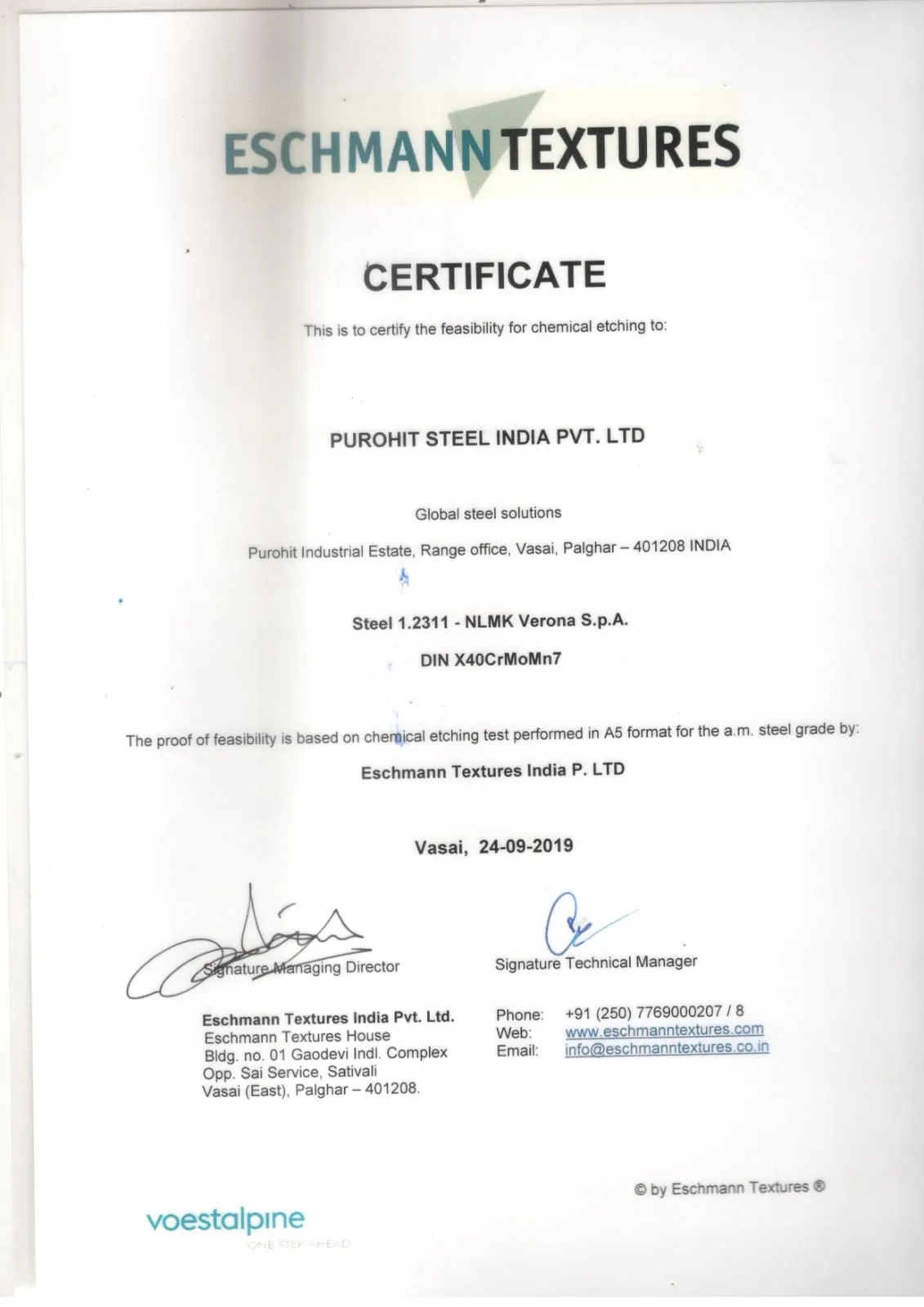
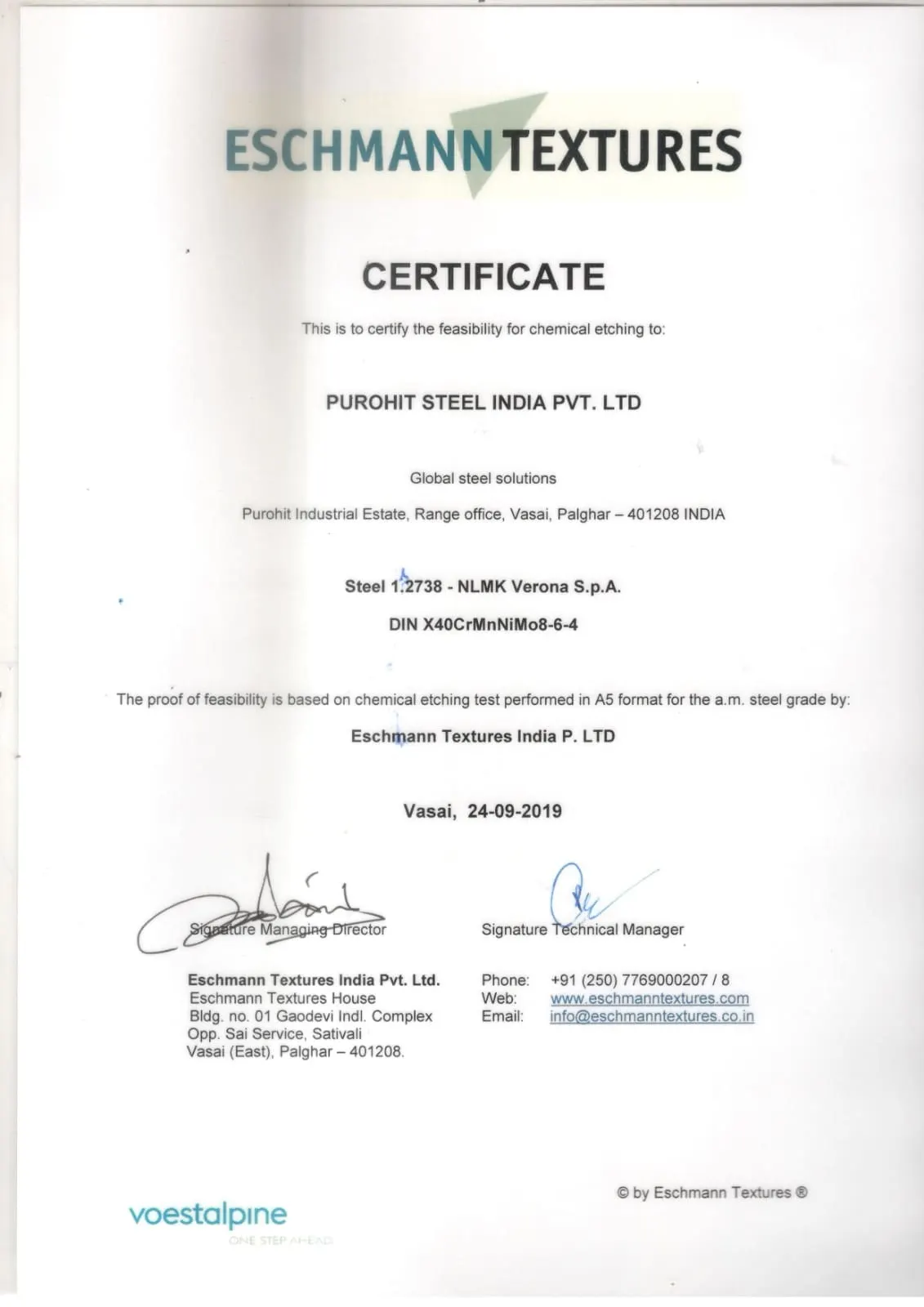
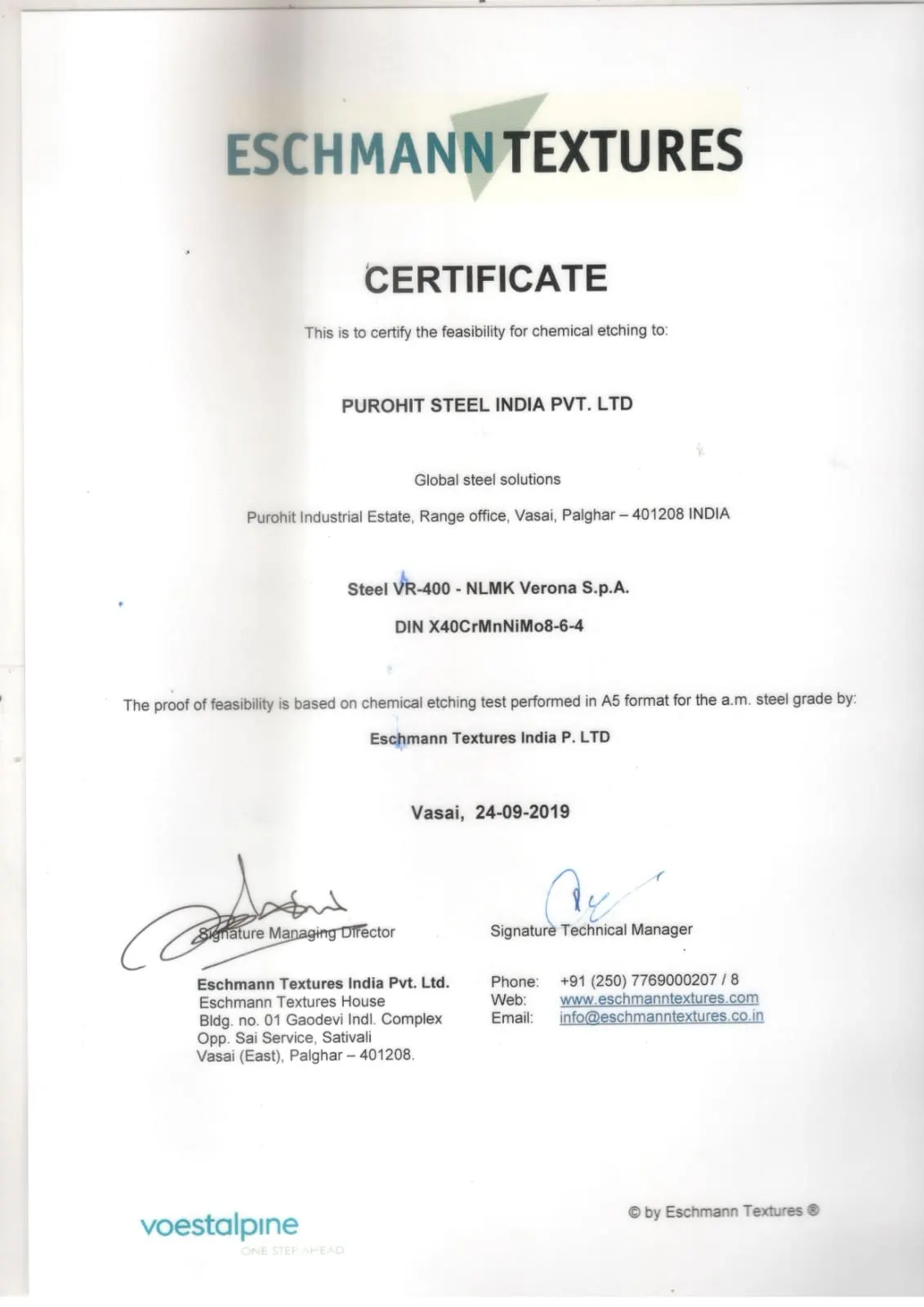
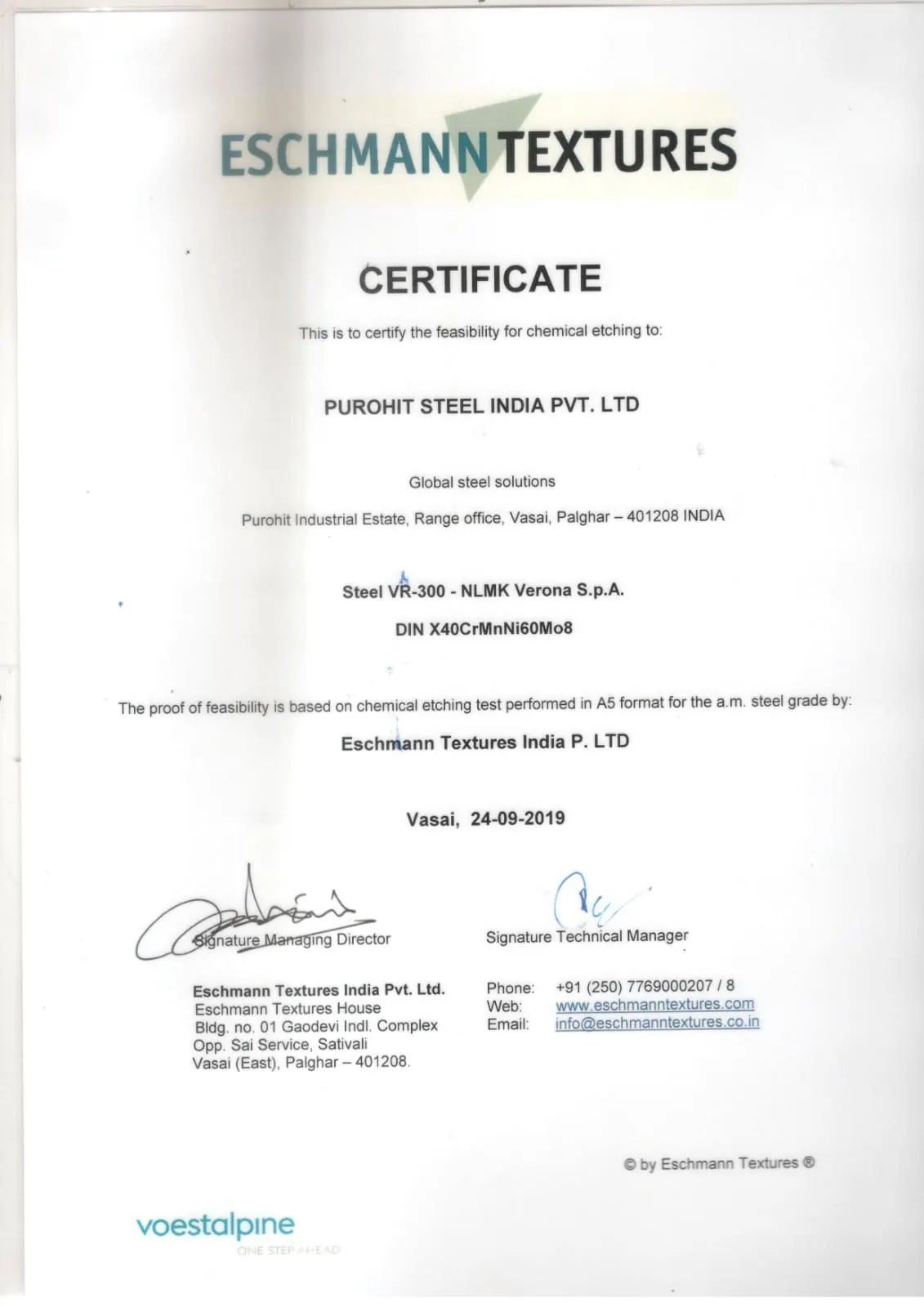
View all certificates in detail on our Certifications page.
Countries We Export Worldwide
Beyond India, Purohit Steel exports tool & mould steel grades to customers across the following countries and regions:
| Export Destinations | |||||
|---|---|---|---|---|---|
| UAE | Saudi Arabia | Oman | Bangladesh | Sri Lanka | Nepal |
| Vietnam | Thailand | Indonesia | Kenya | Nigeria | South Africa |
For export enquiries and destination-specific documentation, please contact our sales team.
Export Packaging & Shipping
Bars, flats and blocks are packed to withstand handling, transit and marine shipment, whether for domestic dispatch or export orders.
- Palletised and strapped packing for round bars, flat bars and blocks
- Moisture-protected wrapping to prevent surface corrosion in transit
- Seaworthy export packing with clear shipping marks and material identification
- Documentation support including packing lists, invoices and mill test certificates for customs clearance
- Shipment by road, rail or sea freight as per order requirement and destination
Quality Inspection & Testing
Every batch held in our stock is checked through documented inspection procedures before dispatch, so mould makers and OEMs receive material with verified, traceable quality.
- Chemical composition verification against mill certificates
- Hardness testing (Brinell / Rockwell) on received stock
- Dimensional inspection as per standard bar and block tolerances
- Visual and surface defect inspection
- EN 10204 2.2 / 3.1 mill test certificates provided on request
- Third-party inspection coordination available for export orders
Full material traceability is maintained from incoming stock through to dispatch for every order.
Latest Price List
Pricing depends on section size, quantity, form (round bar / flat bar / block) and current raw material rates. Indicative guidance is below — contact us for a firm, up-to-date quotation.
| Form | Typical Price Basis |
|---|---|
| Round Bar | Per Kg, based on diameter & length — contact for latest rate |
| Flat Bar / Plate | Per Kg, based on thickness & size — contact for latest rate |
| Block (cut to size) | Per Kg / Per Piece, based on drawing — contact for latest rate |
Prices are subject to change with raw material and freight costs. Share your required size and quantity via the quotation form or WhatsApp for the latest price.
MOQ & Payment Terms
Minimum Order Quantity: Flexible MOQ depending on size and form — from small trial quantities for tooling houses up to bulk orders for OEMs, subject to confirmation at enquiry stage.
Payment Terms: Advance payment / part-advance with balance before dispatch for domestic orders; T/T (bank transfer) or Letter of Credit (LC) for export orders, depending on order value and destination.