
The right tool steel for plastic moulds depends less on the mould's shape and more on what resin is being run through it. Corrosive resins, hygiene-sensitive parts and commodity-resin high-volume tooling each push toward a different grade from Purohit Steel's plastic mould steel range. This guide is organised around the resin and part requirement, not the process, to help you land on the right grade quickly.
If you are looking for a broader, process-driven view of mould-making tool steel that also covers non-plastic tooling contexts, see our companion guide to tool steel for mould making. For the full category overview of plastic mould steel grades, visit our Plastic Mould Steel hub.
Table of Contents
- 1. Why Resin Type Should Drive Grade Selection
- 2. Which Grade Should You Choose — By Resin
- 3. Corrosive Resins (PVC & Halogenated Plastics)
- 4. Food-Contact & Medical Parts
- 5. Large Parts Needing Uniform Hardness
- 6. General-Purpose Commodity Resins
- 7. Why Purohit Steel for Plastic Mould Steel
- 8. Applications & Industries
- 9. Related Products
- 10. Authorized Stockist Brands
- 11. Cities We Supply in India
- 12. Our Services
- 13. Frequently Asked Questions
- 14. About Purohit Steel
- Our Certifications
- Countries We Export Worldwide
- Export Packaging & Shipping
- Quality Inspection & Testing
- Latest Price List
- MOQ & Payment Terms
- People Also Search For
Why Resin Type Should Drive Grade Selection
Two moulds of similar size and complexity can need completely different steel if the resin running through them is different. A mould running general-purpose polypropylene has very different demands from one running PVC, or one moulding food-contact packaging that needs frequent chemical sterilisation. The resin determines:
- Corrosion exposure: Some resins release corrosive by-products during processing (notably PVC), and hygiene-driven cleaning regimes add further chemical exposure independent of the resin itself.
- Cleaning & sterilisation frequency: Food-contact and medical parts are cleaned and sterilised repeatedly with chemicals that also attack unprotected tool steel.
- Section thickness & part size: Larger parts need thicker mould blocks, which raises the bar for through-section hardenability regardless of resin.
- Cost sensitivity: High-volume commodity-resin tooling is usually more cost-sensitive, favouring the lowest-cost grade that meets the job.
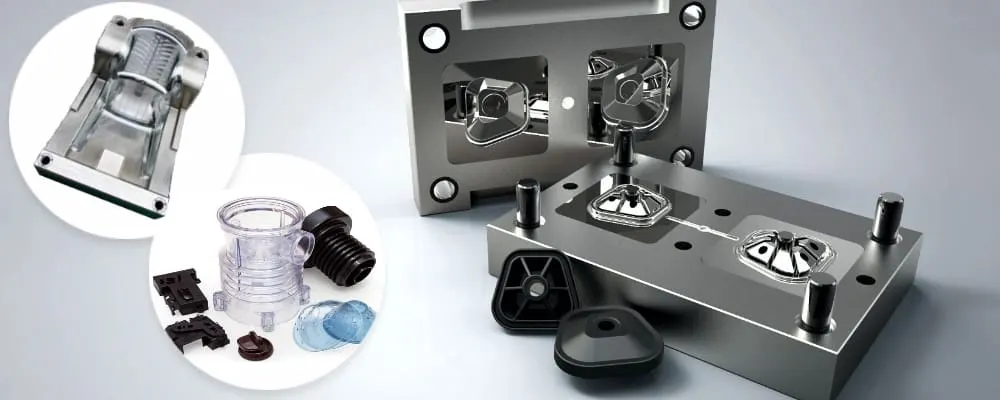
Which Grade Should You Choose — By Resin
| Resin / Part Requirement | Recommended Grade | Why |
|---|---|---|
| PVC, POM/acetal & other corrosive or halogenated resins | VR16 or 1.2083 ESR | Stainless martensitic (VR16, ~14% Cr) or ESR-refined high-Cr (1.2083 ESR) for maximum resistance to corrosive by-products |
| Food-contact, medical & cosmetic packaging (frequent cleaning/sterilisation) | 1.2083 ESR (or 1.2085 as economical alternative) | ESR-refined cleanliness plus high corrosion resistance and mirror-grade polish; 1.2085 offers moderate corrosion resistance at lower cost |
| Water-cooled tooling, humid plant environment, moderate corrosion risk | 1.2085 | 15-17% Cr martensitic stainless, pre-hardened 280-325 HB |
| Large mould blocks / thick sections, general resin, uniform hardness critical | 1.2738 or VR300 | Nickel-added deep hardenability (1.2738), or uniform hardness engineered through 700mm sections (VR300) |
| General-purpose commodity resins (PP, PE, ABS, PS), small-medium moulds | 1.2311 (P20) | Lowest cost, good machinability, adequate for benign, non-corrosive resins |
Some parts combine requirements — e.g. a large food-contact mould may justify 1.2083 ESR despite the higher cost of a bigger block. Use this table as a starting point and confirm against full technical data on each grade page.
Corrosive Resins (PVC & Halogenated Plastics)
PVC and certain flame-retardant or halogenated engineering plastics can release corrosive by-products (such as hydrogen chloride) as they are heated and processed. Over repeated cycles, this attacks the cavity surface of a base Cr-Mn-Mo steel such as 1.2311, leading to pitting and surface degradation that shows up as defects on moulded parts. VR16, a pre-hardened stainless martensitic chromium-molybdenum steel with roughly 14% chromium, is specifically positioned for PVC and other corrosive-plastic moulds; where maximum corrosion resistance and the highest polish are both needed, 1.2083 ESR is the stronger (and costlier) option.
Food-Contact & Medical Parts
Moulds for food packaging, cosmetic containers and medical components are not necessarily processing an aggressive resin, but they are cleaned and sterilised far more often and with harsher chemicals than a typical industrial mould. This ongoing chemical exposure is why base Cr-Mn-Mo grades fall short here even when the resin itself is benign. 1.2083 ESR, an ESR-refined high-chromium stainless-type steel, is the standard recommendation for high-gloss, transparent, food-contact and medical moulds, combining the best available corrosion resistance with the cleanest, most consistently polishable microstructure in the range. 1.2085 offers a more economical step up from base grades where the hygiene requirement is present but less demanding.
Large Parts Needing Uniform Hardness
Independent of the resin, large plastic parts need correspondingly large mould blocks — and a thick block of base 1.2311 can show a meaningful hardness gradient from surface to core after pre-hardening, since the steel's own hardenability limits how deep the quench effect reaches. 1.2738 (P20+Ni) adds nickel specifically to extend that hardenability into thicker sections, and VR300 goes further, engineered by NLMK Verona for uniform hardness distribution through sections up to 700mm — useful for large parts where consistent machinability and polish quality across the whole block matters, such as automotive and large consumer-appliance mould bases.
General-Purpose Commodity Resins
For commodity resins such as polypropylene (PP), polyethylene (PE), general ABS and polystyrene (PS) processed in a dry environment without unusual hygiene demands, base 1.2311 (P20) remains the sensible default: pre-hardened at 280-325 HB, good machinability, and the lowest cost in the plastic mould steel range. There is little practical benefit — and real added cost — in specifying a stainless or nickel-added grade for tooling that does not face corrosion, hygiene or large-section hardenability pressure.
Why Purohit Steel for Plastic Mould Steel
- Full Resin-Matched Range: General-purpose, deep-hardening and stainless corrosion-resistant grades stocked under one roof
- Ready Stock: Round bar, flat bar and block sizes held in inventory for immediate dispatch
- ISO-Certified Quality: Documented quality management since 1965
- Authorized Stockist: Sourced through globally reputed manufacturers, including NLMK Verona and SeAH CSS
- Value-Added Machining: In-house bandsaw cutting, precision machining, grinding, drilling, gun drilling, EDM and wire-cut
- Technical Support: Resin-specific grade-selection guidance from our technical team
- Pan-India & Export Supply: Warehousing in Vasai with a sales outlet in Mumbai
Applications & Industries
- PVC pipe fittings, profiles and window/door hardware moulds
- Food packaging, containers and closures
- Medical and cosmetic component moulds
- Large automotive interior and exterior panel moulds
- Household appliance and consumer product moulds
- General commodity-resin injection moulds
Industries We Serve
- Plastic injection moulding industry
- Packaging & food-contact packaging
- Medical & pharmaceutical packaging
- Automotive industry
- Consumer goods & household appliances
Authorized Stockist



Plastic Mould Steel Supply Locations Across India
We supply plastic mould tool steel across major industrial cities including Mumbai, Pune, Khopoli, Nashik, Aurangabad, Navi Mumbai, Palghar, Umbergaon, Vapi, Valsad, Daman, Vadodara, Ahmedabad, Rajkot, Hyderabad, Bangalore, Chennai, Cochin, Delhi, Gurgaon, Manesar and Sonipat — as well as to export markets.
Our Steel Products
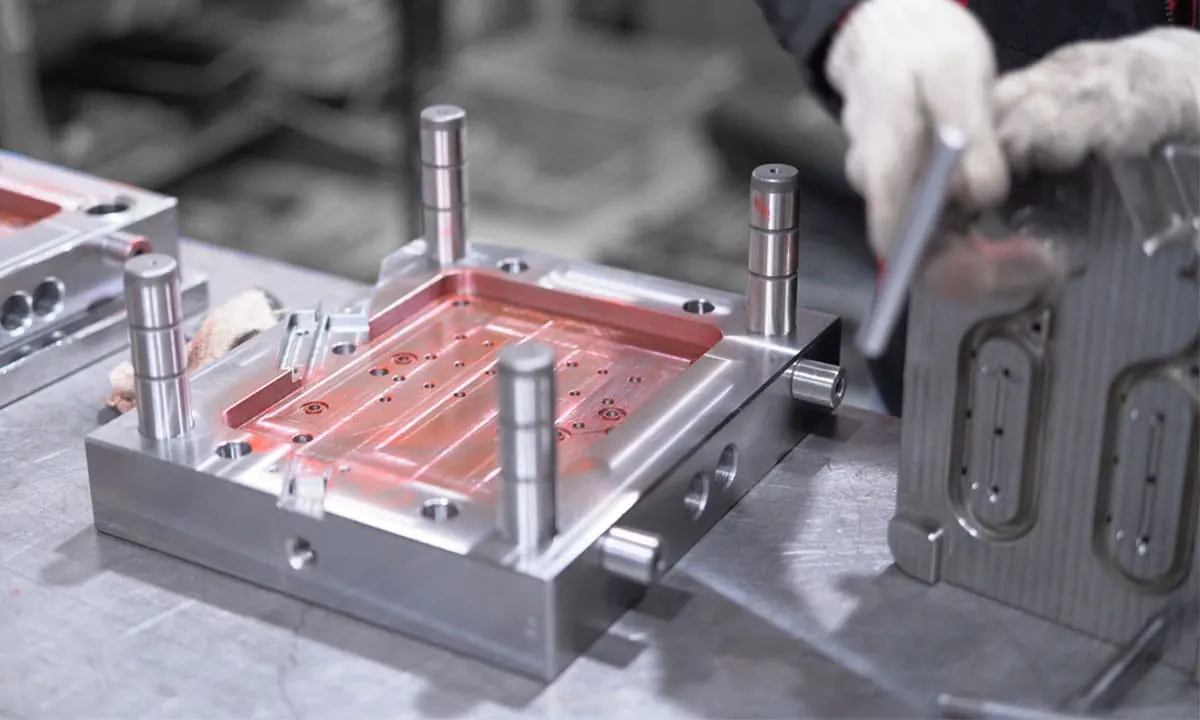
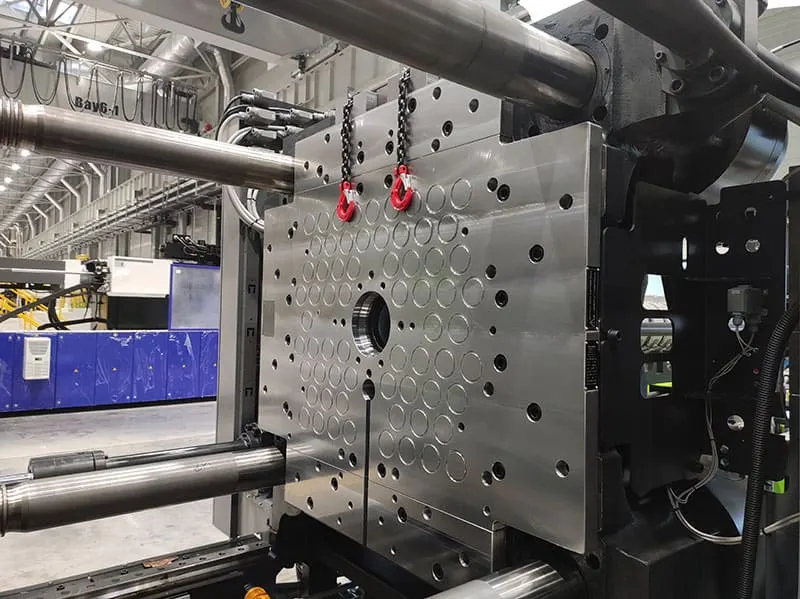
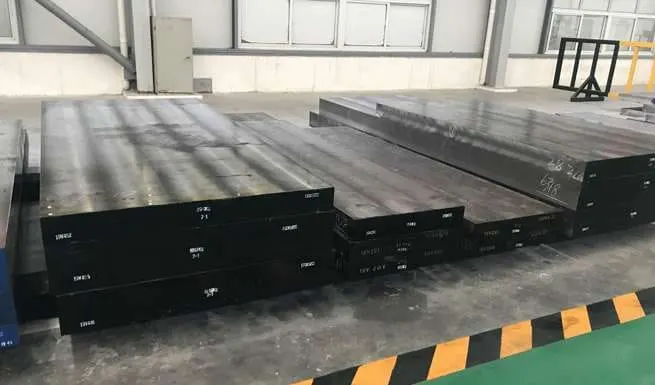
Our Services
Frequently Asked Questions
About Purohit Steel
Purohit Steel was established in 1965 by Shree Bherumalji Rajpurohit, a visionary in metallurgy. Over the decades, we have built a strong reputation as a trusted stockist and exporter of tool steel, plastic mould steel and engineering steel products across India.
As an ISO-certified company, we source premium materials from globally reputed manufacturers and operate a modern warehousing facility in Vasai along with a sales outlet in Mumbai, enabling efficient storage, fast processing and timely delivery across India and export markets.
Read more about Purohit Steel, view our certifications, or get in touch with our technical sales team.
Our Certifications
Purohit Steel operates as an ISO-certified company, backed by documented quality management, safety and compliance certifications that support reliable supply to domestic and export customers.
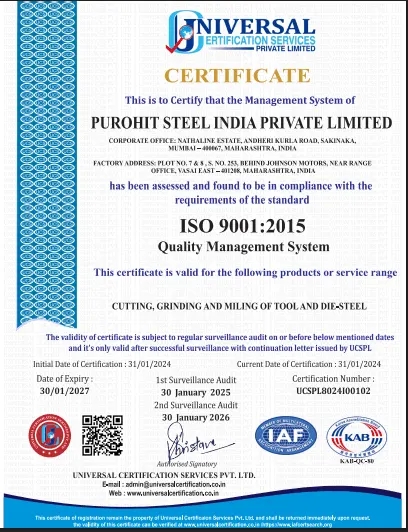
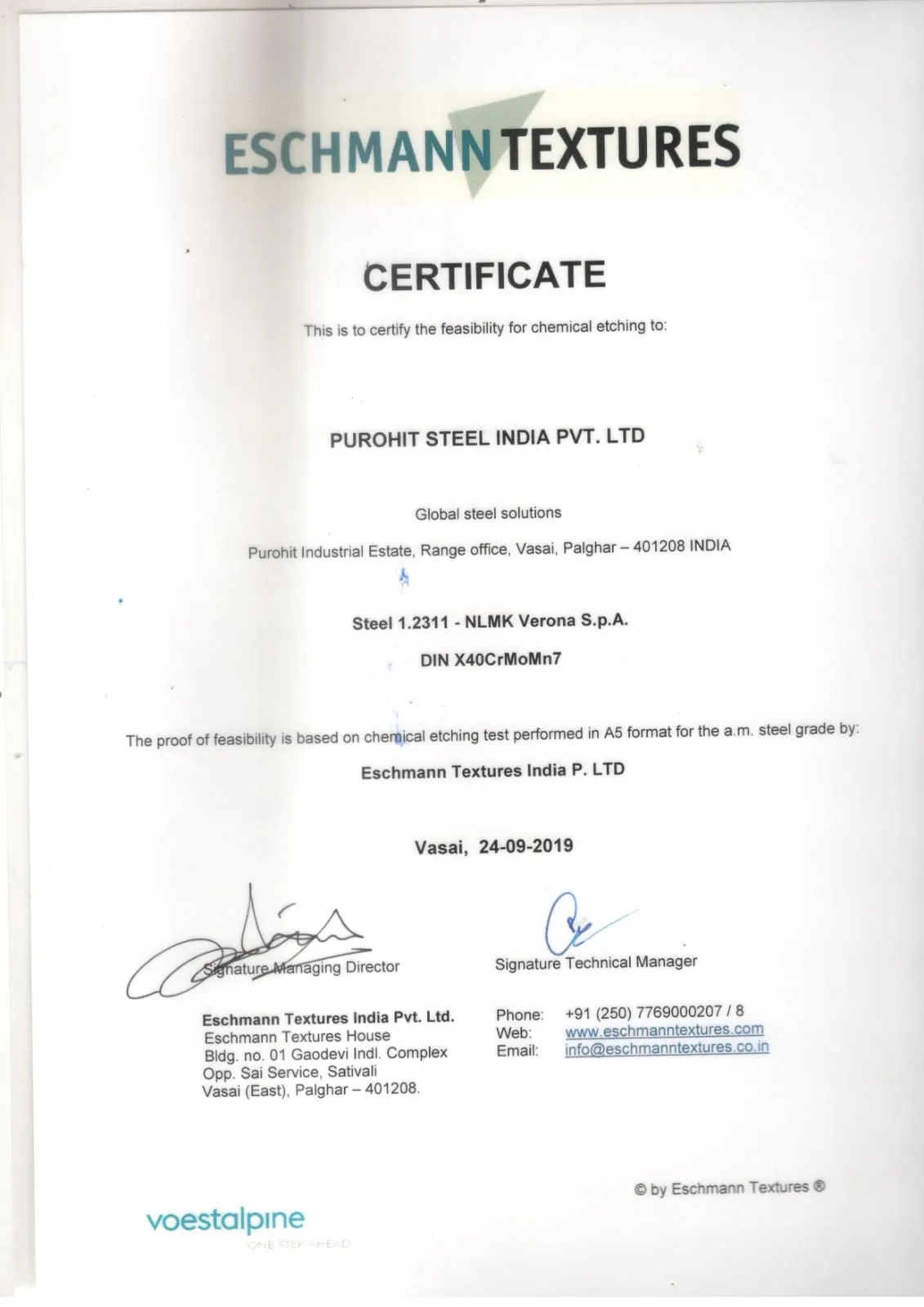
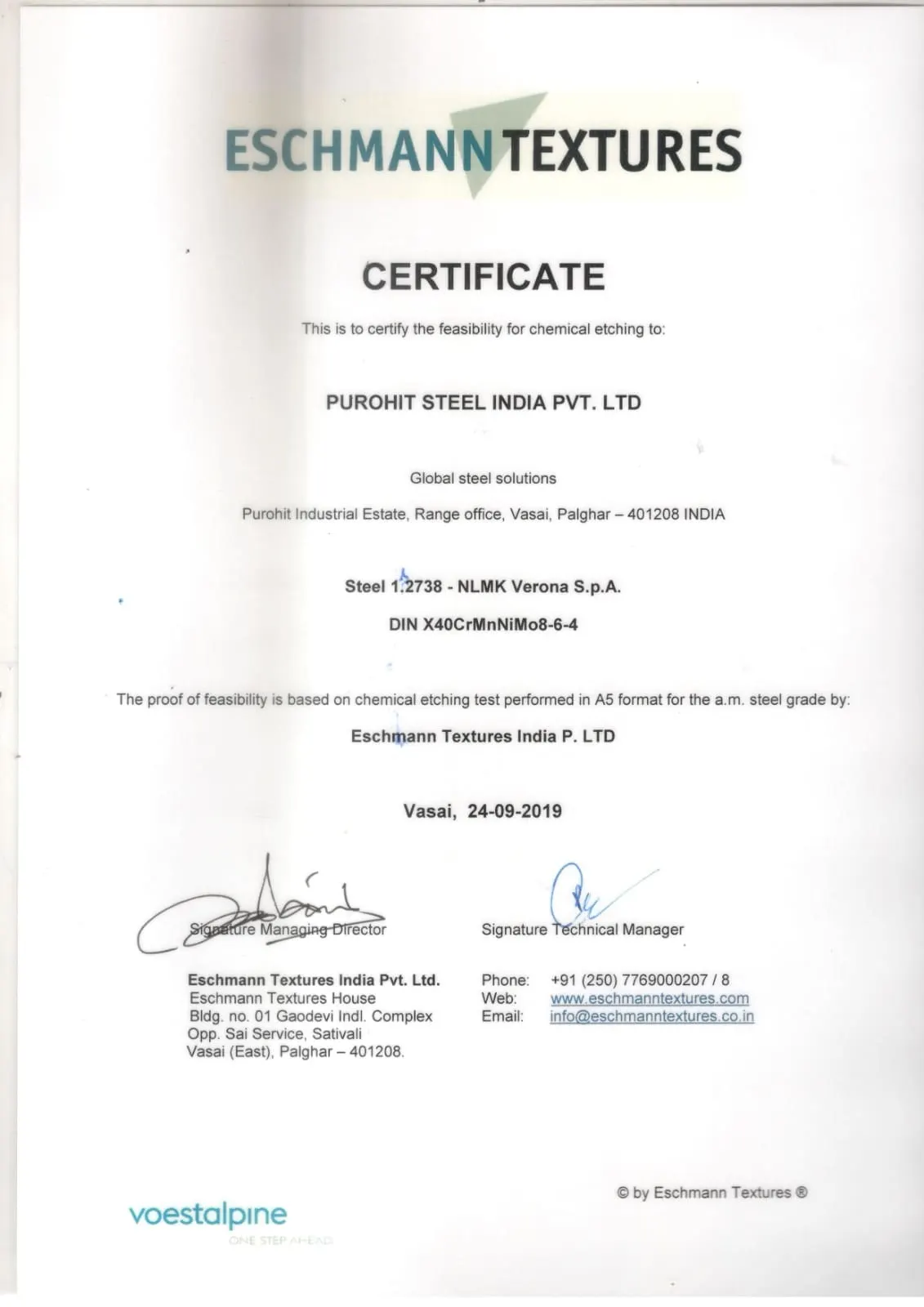
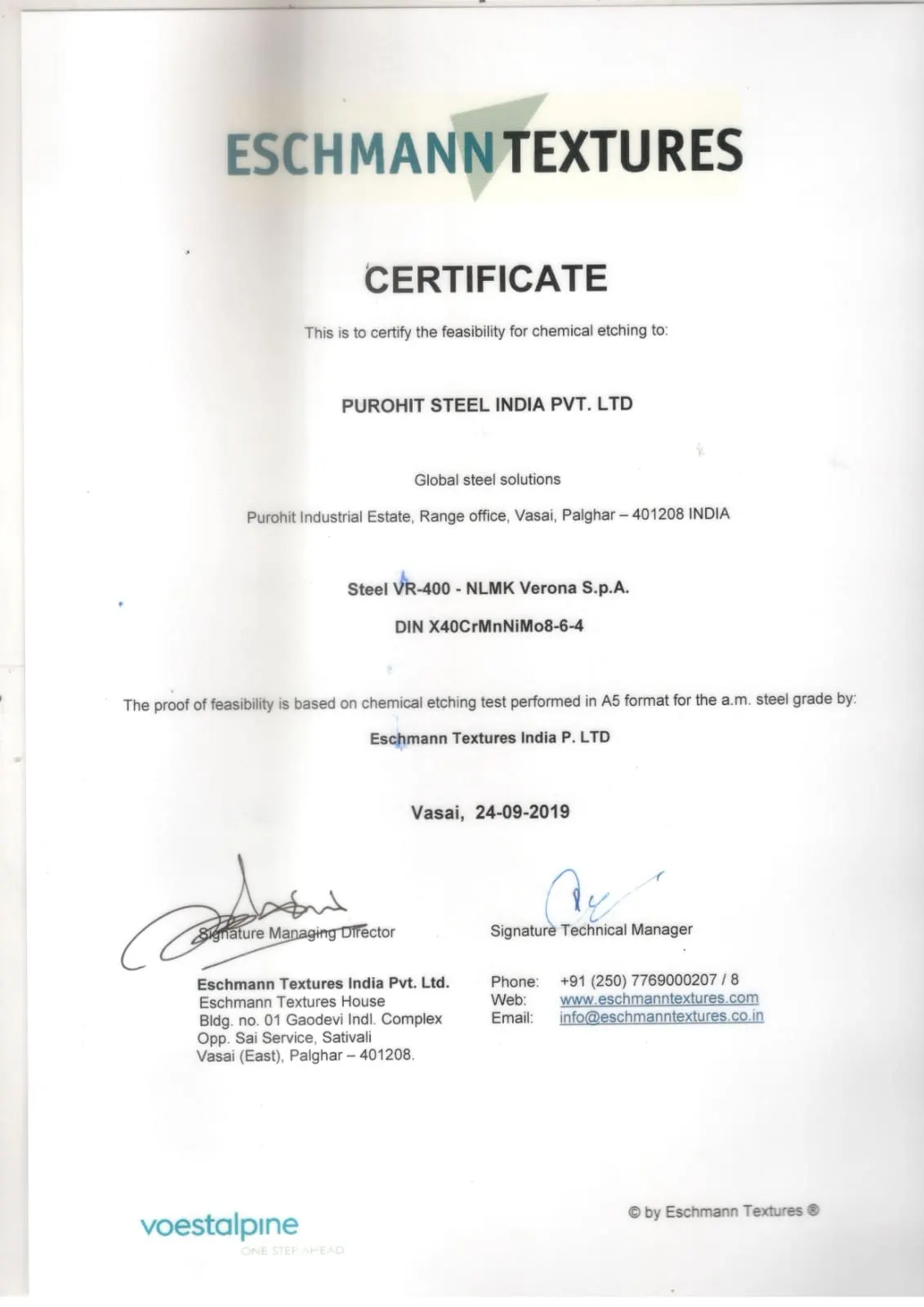
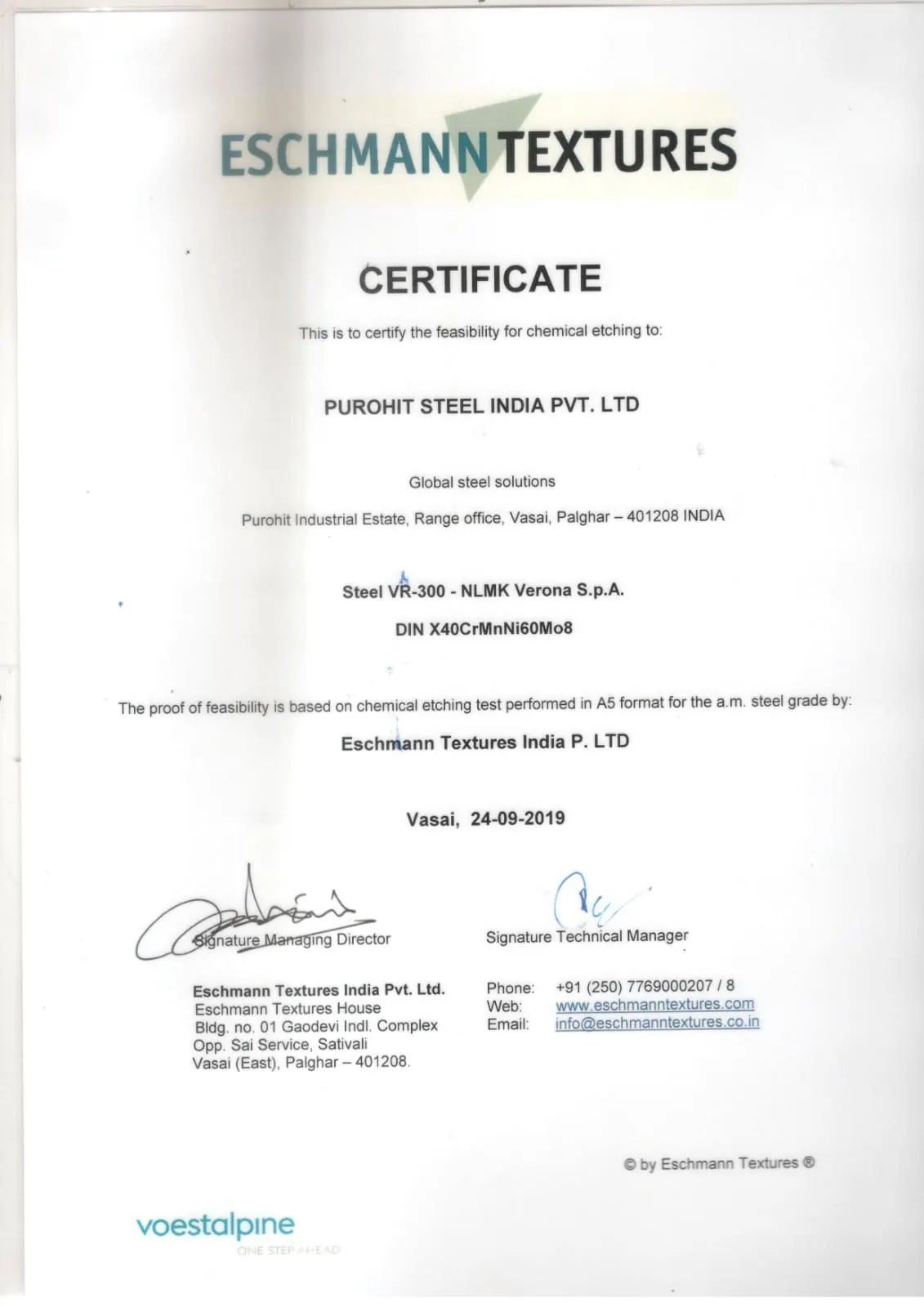
View all certificates in detail on our Certifications page.
Countries We Export Worldwide
Beyond India, Purohit Steel exports tool & mould steel grades to customers across the following countries and regions:
| Export Destinations | |||||
|---|---|---|---|---|---|
| UAE | Saudi Arabia | Oman | Bangladesh | Sri Lanka | Nepal |
| Vietnam | Thailand | Indonesia | Kenya | Nigeria | South Africa |
For export enquiries and destination-specific documentation, please contact our sales team.
Export Packaging & Shipping
Bars, flats and blocks are packed to withstand handling, transit and marine shipment, whether for domestic dispatch or export orders.
- Palletised and strapped packing for round bars, flat bars and blocks
- Moisture-protected wrapping to prevent surface corrosion in transit
- Seaworthy export packing with clear shipping marks and material identification
- Documentation support including packing lists, invoices and mill test certificates for customs clearance
- Shipment by road, rail or sea freight as per order requirement and destination
Quality Inspection & Testing
Every batch held in our stock is checked through documented inspection procedures before dispatch, so mould makers and OEMs receive material with verified, traceable quality.
- Chemical composition verification against mill certificates
- Hardness testing (Brinell / Rockwell) on received stock
- Dimensional inspection as per standard bar and block tolerances
- Visual and surface defect inspection
- EN 10204 2.2 / 3.1 mill test certificates provided on request
- Third-party inspection coordination available for export orders
Full material traceability is maintained from incoming stock through to dispatch for every order.
Latest Price List
Pricing depends on section size, quantity, form (round bar / flat bar / block) and current raw material rates. Indicative guidance is below — contact us for a firm, up-to-date quotation.
| Form | Typical Price Basis |
|---|---|
| Round Bar | Per Kg, based on diameter & length — contact for latest rate |
| Flat Bar / Plate | Per Kg, based on thickness & size — contact for latest rate |
| Block (cut to size) | Per Kg / Per Piece, based on drawing — contact for latest rate |
Prices are subject to change with raw material and freight costs. Share your required size and quantity via the quotation form or WhatsApp for the latest price.
MOQ & Payment Terms
Minimum Order Quantity: Flexible MOQ depending on size and form — from small trial quantities for tooling houses up to bulk orders for OEMs, subject to confirmation at enquiry stage.
Payment Terms: Advance payment / part-advance with balance before dispatch for domestic orders; T/T (bank transfer) or Letter of Credit (LC) for export orders, depending on order value and destination.